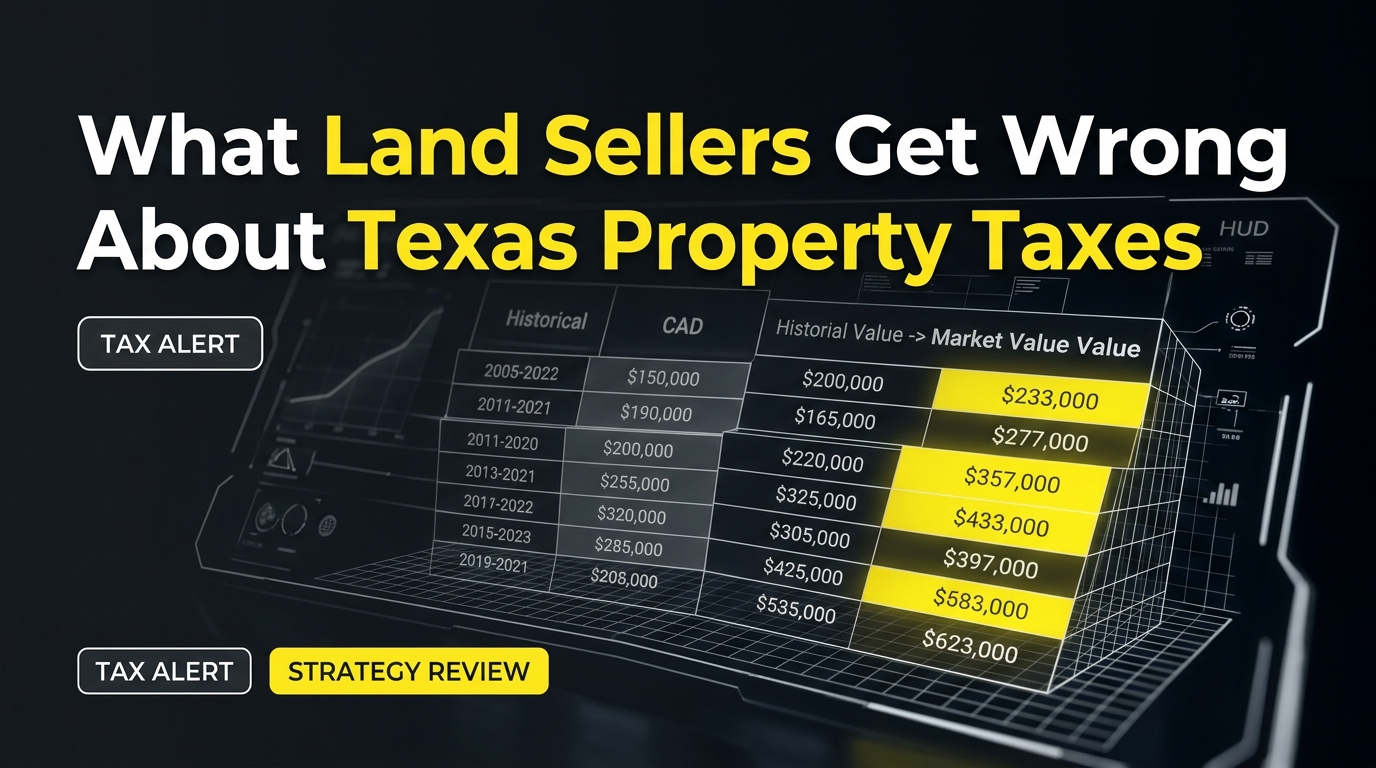
What Land Sellers Get Wrong About Texas Property Taxes
What Land Sellers Get Wrong About Texas Property Taxes
By: Bhaskar Pandey
Texas is famous for a lot of things. We have incredible barbecue, endless big skies, and a booming economy driven by the fact that we have no state income tax. But to make up for that missing income tax, our property taxes are robust, to say the least. As a land wholesaler and broker who has closed countless transactions across the state, I have noticed a recurring theme. Property taxes are almost always an afterthought for land sellers right up until the exact moment a buyer brings them up at the negotiation table.
Sellers tend to focus entirely on the gross sales price. They look at the big number they want to hit and ignore the complex web of tax implications that can eat into their net proceeds or scare a buyer away entirely. When you are selling land, understanding how Texas property taxes work is not just a job for your CPA or your title company. It is a critical piece of your sales strategy. If you walk into a negotiation blind to your own tax situation, you are going to get outmaneuvered by a savvy buyer. Let us break down exactly what land sellers get wrong about property taxes, how these misunderstandings kill deals, and what you need to know before you ever put a sign in the dirt.
The Disconnect Between CAD Values and Market Value
The most common conversation I have with sellers usually starts with them holding a piece of paper from their local appraisal district. Whether you are dealing with the Tarrant Appraisal District up in the Dallas-Fort Worth metroplex or any other county authority in the state, there is a fundamental misunderstanding of what that assessed value actually means. Sellers often think the CAD value is a ceiling for their property taxes and a baseline for their asking price. In reality, the county’s assessed value and the true market value of your land are rarely the same number.
Appraisal districts use mass appraisal techniques that almost always lag behind the actual market by a year or more. Furthermore, Texas is a non-disclosure state, meaning the final sale price of a property does not legally have to be reported to the county. Because of this, CAD values are essentially educated estimates. When you sell your land for a price that is significantly higher than the current CAD value, the county is eventually going to find out. They have their ways of estimating new values, often looking at public listing prices, mortgage deed records, and shifting neighborhood data.
Why does this matter to you as a seller? Because an experienced buyer knows their future tax bill is going to spike. If a buyer is looking at a piece of land in Tarrant County that is currently assessed at one hundred thousand dollars, but you are selling it to them for five hundred thousand, that buyer is calculating their future holding costs based on the higher number. If you are not prepared for a buyer to use this future tax burden as a lever to negotiate your asking price down, you will be caught completely off guard. You have to understand that your current low tax bill does not magically transfer to the new owner if the market value has skyrocketed. Buyers price in their future risks, and taxes are a massive risk.
The Danger of Exemption Rollback Taxes
This is perhaps the most dangerous trap for Texas land sellers, and it is where I see the most money lost at the closing table. Texas offers incredibly generous agricultural and wildlife valuations to landowners. These are often referred to as exemptions, though they are technically special valuations that tax the land based on its productive agricultural capacity rather than its highest and best use market value. These valuations keep holding costs to absolute pennies on the dollar. However, what sellers frequently get wrong is the painful concept of rollback taxes.
When you sell your ag-exempt land to a developer who is going to pave it over and build a subdivision, the county immediately changes the use of the land. When the agricultural use is abandoned, the county triggers a rollback tax. This means the county will charge the difference between the taxes paid under the ag valuation and the taxes that would have been paid at standard market value, looking backward for the previous three years, plus a substantial interest penalty.
I recently saw a deal down in Bexar County where a family was selling a beautiful fifty-acre pasture. They had maintained an ag exemption through cattle grazing for decades. They found a commercial buyer willing to pay top dollar, and everything was going smoothly until the title company brought up the rollback taxes. The seller assumed the buyer would pay it since the buyer was the one changing the use. The buyer assumed the seller would pay it out of their massive sale profits. The deal almost completely fell apart over a six-figure tax surprise. As a seller, you must negotiate who is responsible for the rollback taxes upfront in the real estate contract. If you leave it to chance, you might find your net proceeds drastically reduced on closing day.
The Reality of Property Tax Prorations
Another area where sellers get an unpleasant surprise is on the final settlement statement regarding tax prorations. In Texas, property taxes are paid in arrears. This means that the tax bill you receive in October or November of this year is actually paying for the period from January first to December thirty-first of the current year.
Because of this system, the seller owes the property taxes for the exact number of days they owned the property during the year of the sale. If you close on your land on June thirtieth, you are responsible for exactly half of the year’s property taxes. Since the actual tax bill for the current year usually has not been issued by the county yet, the title company will estimate the taxes based on the previous year's bill and prorate that specific amount.
At closing, the buyer receives a financial credit from you for your portion of the taxes. Later that year, the buyer is responsible for paying the entire twelve-month bill when it comes due. Sellers who do not account for this proration often stare at their closing documents wondering where several thousand dollars went. It is a standard real estate practice, but if you have not mentally budgeted for that deduction from your gross proceeds, it can sting.
How Tax Liens Hijack Title Searches
It should go without saying that property owners have to pay their taxes, but life happens. Sometimes a landowner inherits a property from a relative and does not realize the taxes have gone unpaid for several years. Sometimes temporary financial hardship hits. What sellers get wrong here is thinking they can just sell the property and let the new owner worry about the back taxes, or they assume the title company will just take the money out of the sale proceeds without it causing a major delay.
Unpaid property taxes automatically attach to the land as a priority lien. When a buyer puts your property under contract, the title company will pull a title commitment to verify ownership. If there are delinquent taxes, penalties, and interest tied to the parcel, the title company will require them to be paid off completely at or before closing. You simply cannot transfer a clean, general warranty deed with a tax lien hanging over it.
Furthermore, if the county has initiated a tax foreclosure lawsuit against the property, the legal fees associated with that suit will also be tacked onto your final bill. I have seen situations where the back taxes and escalating penalties were so high they completely wiped out the seller's equity, making it impossible to sell without actually bringing cash to the closing table. If you are behind on your taxes, you need to be completely transparent about it with your broker from day one so the numbers can be calculated accurately.
Using Low Taxes as a Strategic Asset
Up to this point, we have talked about taxes as a liability or a hurdle to overcome. But what many sellers get wrong is failing to use their low property taxes as an aggressive marketing tool. If you have done the hard work to establish and maintain a wildlife management valuation or a solid agricultural exemption, you possess a highly liquid asset.
Buyers, especially investors and recreational buyers who plan to hold the land for a long time, are terrified of high holding costs. If you can hand them a property in Bexar County or Tarrant County where the taxes are only a few hundred dollars a year despite the rising property values, you have a massive competitive advantage in the marketplace.
You should not just passively mention the exemption in the listing description. You need to actively sell the fact that the holding costs are heavily minimized. Provide the buyer with the exact wildlife management plan you have been using. Show them the grazing lease you have with the neighboring rancher. Give them a turnkey solution to keep those taxes low after they take ownership. When you prove to a buyer that they can park their capital in your land without bleeding cash every year to the local appraisal district, you can often command a much higher purchase price.
Final Thoughts
Property taxes are an unavoidable reality of selling real estate in Texas. They heavily influence how a buyer values your land, how much money you actually walk away with at closing, and how smoothly the transaction process goes. Waiting for the title company or the buyer's agent to explain these numbers to you is a terrible strategy that puts you on the defensive. You need to be proactive, understand your local appraisal district's methods, prepare for potential rollback scenarios, and know exactly what your prorated liabilities will be.
At Builders Land Source, we do not just look at the top-line sales price. We help Texas landowners understand every single cost layer before we ever list a property or make a wholesale offer. We believe in transparency and preparation because surprises at the closing table are rarely good for the seller. If you are considering selling your land and want a clear, honest picture of your true net value, contact Builders Land Source today. We will help you navigate the tax realities and get the absolute best outcome for your property.


