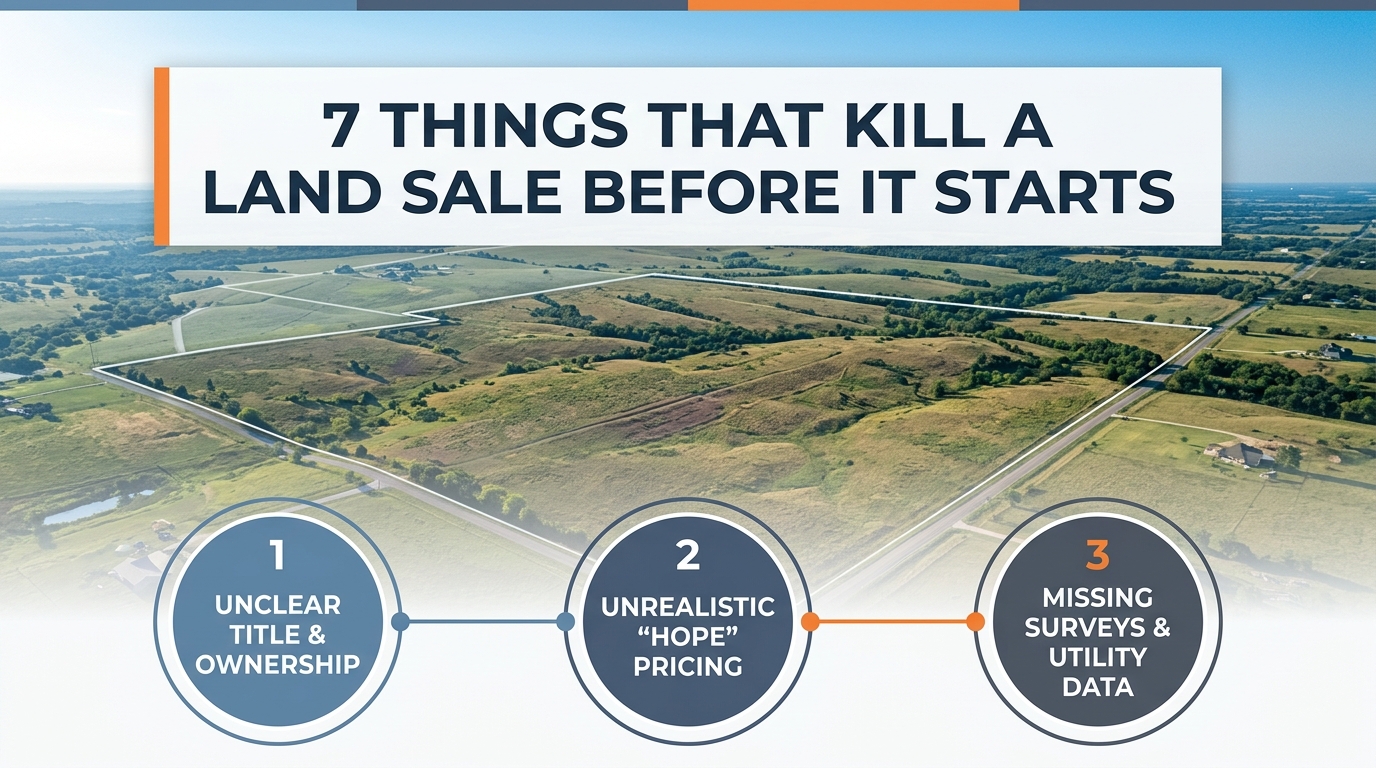
7 Things That Kill a Land Sale Before It Even Starts
7 Things That Kill a Land Sale Before It Even Starts
By: Bhaskar Pandey, Land Wholesaler & Broker, Builders Land Source
I’ve seen it a thousand times. A landowner calls me, sounding defeated. They’ve had their property on the market for eighteen months, they’ve dropped the price twice, and they haven’t received a single serious phone call. They think the market is "dead" or that their land is somehow cursed.
The truth? Usually, the sale was dead before they even hammered the "For Sale" sign into the dirt.
Selling land isn't like selling a house. You aren't selling granite countertops and crown molding; you are selling a vision, a set of rights, and a complex bundle of technical data. If you skip the prep work, you aren't just slowing down the sale—you’re activeley repelling the best buyers. At Builders Land Source, we see these "deal killers" daily. If you want to actually move your acreage this year, stop making these seven mistakes.
1. Unclear Title and Ownership Issues
Nothing halts a closing faster than a "cloud" on the title. Whether it’s an old tax lien, a long-lost heir who never signed off on a previous deed, or an undischarged mortgage from twenty years ago, title issues are the ultimate momentum killers.
The Consequence: A buyer falls in love with the land, you agree on a price, and three weeks into escrow, the title company finds a snag that takes six months to clear. The buyer gets cold feet, pulls their earnest money, and leaves you with a "stale" listing and a legal headache.
The Quick Fix: Run a preliminary title search before you list. Clear up any liens or "heirship" issues now so you can hand a clean file to the buyer on day one.
2. Unrealistic Pricing (The "Hope" Strategy)
Landowners often price their property based on what they need to get out of it or what a neighbor told them they heard someone else got three years ago. If you price your land at $200,000 when the hard comps say $150,000, you are essentially invisible to serious developers and investors.
The Consequence: You miss the "golden window" of the first thirty days when your listing is fresh. By the time you finally drop the price to market value, buyers will wonder what is fundamentally wrong with the dirt because it has been sitting for so long.
The Quick Fix: Forget what you "want" and look at the "sold" data from the last six months. Price it to be the next property to sell, not the one that sits on the shelf.
3. No Survey or an Outdated Survey
In Texas, boundaries shift, fences move, and old surveys from the 1970s often use "metes and bounds" that refer to trees or rocks that no longer exist. If you can't tell a buyer exactly where your corners are, you don't really have a product to sell yet.
The Consequence: A buyer might want to build a fence or a barn but won't pull the trigger because they are afraid of encroaching on a neighbor. Without a current survey, most banks won’t even consider financing the deal, cutting your buyer pool in half.
The Quick Fix: Invest in a new boundary survey. Having a fresh, stamped PDF ready to email a prospect shows you are a professional and removes a massive hurdle to the sale.
4. Total Lack of Utility Information
"Utilities available nearby" is the most hated phrase in land sales. Does that mean the power line is at the road, or three miles away? Is there a water meter, or will the buyer spend $25,000 drilling a well? If you don't have these answers, you’re asking the buyer to do your homework.
The Consequence: Experienced builders will simply skip your listing for one that provides a "utility letter" or clear capacity stats. They aren't going to gamble their construction budget on an "I think so" regarding water and sewer.
The Quick Fix: Call the local co-op and the water district. Get it in writing: "Yes, there is a 6-inch water main at the road with capacity for a new meter."
5. Poor Presentation and No Property Photos
I am still shocked by listings that feature one blurry photo taken from the window of a moving truck—or worse, just a screenshot of a Google Map. Land is emotional. If a buyer can’t see the "build site," the trees, or the view, they won’t feel the urge to drive two hours to see it in person.
The Consequence: You’ll only attract "bottom feeders" looking for a fire sale because your listing looks like an afterthought. High-quality buyers associate professional photos with high-quality land.
The Quick Fix: Clear the brush from the entrance and hire a drone photographer. A few hundred dollars for aerial shots and 4K ground photos can add thousands to your final sales price.
6. Selling Through the Wrong Channel
Listing a 20-acre raw tract with a residential realtor who mostly sells suburban condos is a recipe for disaster. Land is a different animal; it requires knowledge of soil types, floodplains, and ag-exemptions—things most residential agents simply don't deal with.
The Consequence: Your agent won't know how to "sell the dirt" to a developer or farmer, and they won't have the right network to find land-specific buyers. The property will sit, and the agent will eventually suggest a price drop because they don't know how to market the features.
The Quick Fix: Work with a land specialist or a broker who understands land-use and wholesale mechanics. You need someone who speaks the language of "topography" and "easements," not "open houses" and "curb appeal."
7. Ignoring Zoning Details and Restrictions
If your land is restricted to "Site-Built Homes Only" but you’re trying to sell it to someone who wants to park a mobile home or an RV, you are wasting everyone’s time. Likewise, if it’s zoned residential but you’re pricing it like commercial frontage, the deal is dead on arrival.
The Consequence: You spend weeks in negotiations only for the buyer to find out during their due diligence that they can't actually use the land for their intended purpose. The deal collapses at the eleventh hour, and you’re back to square one.
The Quick Fix: Read your deed restrictions and check with the county planning department. Know exactly what can—and cannot—be built on your dirt before you ever talk to a buyer.
Conclusion
Selling land is a process of eliminating "No’s." Every one of the items above is a reason for a buyer to say "No" and move on to the next parcel. By taking care of your title, your survey, and your utility data upfront, you are making it incredibly easy for a buyer to say "Yes."
You shouldn't have to guess what is holding your sale back. At Builders Land Source, we specialize in cutting through the noise and getting land deals to the finish line. We handle the heavy lifting of valuation and market positioning so you can move on to your next chapter.
If you’re tired of your land sitting on the market, let’s talk. Contact Builders Land Source today for a free land valuation consultation. We’ll help you spot the deal killers before they cost you another year of property taxes.


